Why Most Cyclists Over 40 Feel Stuck (Even Though They’re Training Hard)
The Climb (#174)
One of the biggest lessons I’ve learned as I’ve got older is that training harder isn’t always the answer.
In fact, for most cyclists over 40, it’s usually the thing keeping them stuck.
I realised this myself when I started noticing I couldn’t ride hard every day anymore and keep seeing progress the way I used to. Even when I had a really good training block and my numbers were improving, it almost always ended the same way eventually.
Burnout. Fatigue. Illness. Time off the bike.
I’d push through tiredness, ignore the warning signs, and eventually my body would force me to stop anyway.
And over the years, after seeing thousands of health assessments and coaching more cyclists balancing careers, family life, and training, I realised something:
Most cyclists over 40 aren’t under-training.
They’re under-recovering.
The Signs Are Usually There

The interesting thing is most people know something feels off before they admit it.
I see cyclists who are exhausted all the time. They’re still training, still showing up, but mentally they’re just going through the motions instead of genuinely enjoying it.
Their weight isn’t moving despite riding consistently. Their FTP has plateaued. Their motivation is low. Sleep is poor.
And when you dig deeper, the pattern is usually the same.
They’re trying to cram too much into already stressful lives.
Work. Family. Early mornings. Late nights. Hard sessions squeezed into every available gap.
Then they wonder why they feel flat on every ride.
I’ve experienced it myself. I’ve gone out on rides during periods of overtraining and felt absolutely terrible. Legs empty. No energy. No enjoyment. You finish the ride feeling worse than when you started.
That’s normally the point where your body is asking for recovery, not more intensity.
Most Cyclists Think They Need To Do More
This is probably the biggest misconception I see.
Most cyclists think the answer is more riding.
More commuting. More weekend miles. More training sessions squeezed into busy weeks.
There’s still this belief that more is always better.
But what I’ve learned from both coaching and my own riding is this:
More structured time is better than just more time.
Every ride should have a purpose.
Every session should create a specific adaptation.
And recovery should be viewed as part of the training plan, not separate from it.
That’s where most people go wrong. They treat recovery like something optional instead of the thing that actually allows progress to happen.
Sleep Changes Everything

If there’s one thing that sits at the foundation of good health and performance, it’s sleep.
Nothing comes close.
You can have the perfect training plan and perfect nutrition, but if your sleep is poor, eventually everything starts to break down.
I always aim for eight to nine hours where possible, along with a proper wind-down routine before bed. But the reality is, this is normally the first thing people sacrifice.
They stay up too late trying to get more done, then still wake up early to fit training around work and family life.
Six hours becomes normal.
Then fatigue becomes normal.
And eventually poor performance becomes normal too.
The healthier you are off the bike, the healthier you are on the bike.
That includes sleep, stress management, blood pressure, body composition, nutrition, and your mental wellbeing too.
Cycling can absolutely help with stress, but it shouldn’t be the only tool you have.
Things like walking, mobility work, meditation, journaling, therapy, and simply slowing down more can make a massive difference to how well your body responds to training.
One Of The Biggest Mistakes I See
A huge mistake cyclists make is blindly following training plans without listening to their body.
They feel tired, exhausted, mentally drained… but still force themselves to tick every box because the session is on the calendar.
Then if they miss a workout, they try to make it up later in the week.
That almost always backfires.
I always tell my clients:
Forget the missed session. Move on.
Focus on getting the most out of the next session instead.
Because consistency beats perfection every single time.
You Don’t Need Huge Hours To Improve
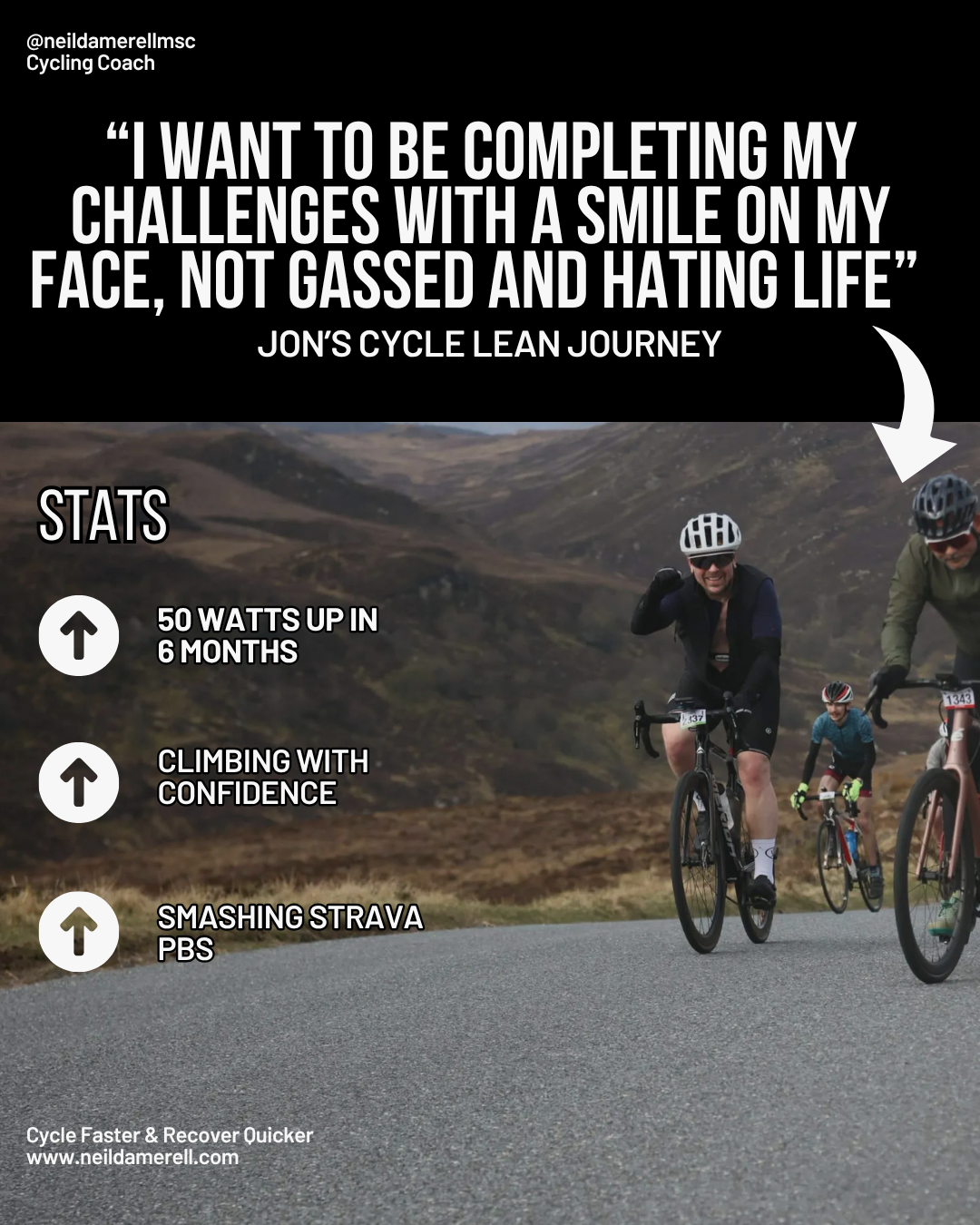
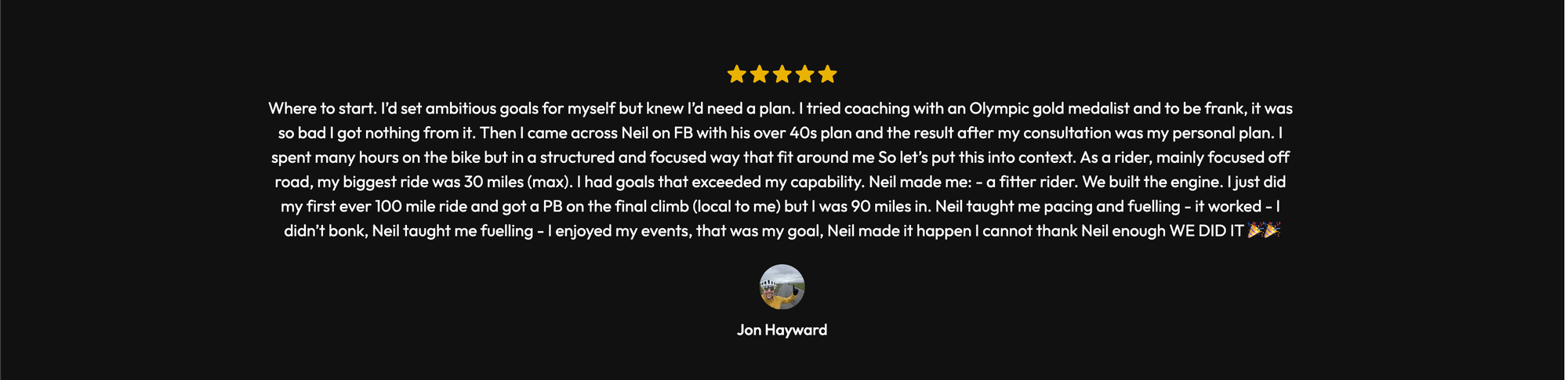
One of the best examples of this recently has been a client called John.
When we started working together, he’d never ridden more than 30 miles on the road. Mostly mountain biking. No big climbs. Busy job. Family life. Very limited time to train.
His goal wasn’t even performance-based at first.
He just wanted to enjoy riding more and get to the top of climbs without feeling miserable.
Fast forward four or five months and he’s now completed a 100-mile sportive alongside a 100km event the week before.
He’s gained around 50 watts in FTP.
His pacing is better. His fuelling is better. His confidence is better.
And the best part?
He finished his 100-mile ride still smiling and even got a personal best on the final climb 90 miles into the ride.
All while averaging around six to eight hours of training per week.
That’s what good structure does.
My Own Approach Has Changed Too
As I’ve got older, my relationship with training has changed massively.
When I was younger, everything was about performance outcomes. PBs. Times. Numbers.
Now?
I care far more about staying healthy, strong, fit, and capable long term.
I still enjoy pushing myself and seeing what I can do, but I’m not willing to sacrifice my health, my relationships, or my life off the bike just to chase numbers that ultimately don’t mean much outside of cycling.
Cycling has become a vehicle to help me stay healthy physically and mentally.
That mindset shift has honestly made me enjoy riding more than ever.
If You Feel Stuck Right Now
The first thing I’d tell you to do is look at the structure of your current training.
Not just how much you ride, but what you’re actually doing.
Are all your rides the same?
Are you constantly riding at one pace?
Have you been repeating the same routine for months without changing anything?
If so, start simple.
One interval session per week.
One easy Zone 2 ride.
One good weekend ride.
Do that consistently for three to four weeks and you’ll almost certainly start seeing progress again.
And the best part is, that can happen with as little as four to eight hours of quality riding per week.
Because after 40, the goal isn’t to do more.
It’s to recover well enough to benefit from the work you’re already doing.
Whenever you're ready, here are the ways I can help you:
- The Cycle Lean Collective: Personalised 1:1 Coaching for Cyclists Who Want to Drop 6–12 kg and Add Up To 60 Watts of FTP While Riding 6-8 hours a Week!
- The Cycle Lean Blueprint: The science-backed 12-week blueprint to cycle leaner, climb stronger, and become the most resilient version of yourself.
I am an ambassador for:
Awesome Supplements: Award Winning Supplements — Our plant-based awesome protein powder is 100% UK-made with low-sugar, gluten & dairy-free.
The best protein powder I have ever tasted.
Get 10% off any product/ every time you make a purchase when using my code: DAMERELL10 at Awesome Supplements.