The Complete Guide to Periodisation for Cyclists Over 40: Building Strength While Preventing Burnout

The Climb (#177)
Introduction
Most cyclists over 40 don’t struggle because they lack effort.
They struggle because they’re trying to improve with a training approach that doesn’t match their life anymore.
They’re working full-time. They’ve got family commitments. They’re carrying more stress than they did in their twenties. Their sleep might not be perfect. Their recovery is slower. Their strength might be starting to decline.
Yet the default answer is still usually the same.
Ride more. Do more intervals. Push harder.
I’ve seen this pattern so many times with the cyclists I coach. They come to me tired, frustrated, and wondering why their FTP has plateaued or why they keep getting ill every time they start to build momentum.
The problem usually isn’t a lack of training.
It’s a lack of structure.
That’s where periodisation comes in.
Periodisation is just a fancy word for planning your training in phases. Instead of trying to be fit all year round, you build fitness, recover, adapt, and then build again.
For cyclists over 40, this matters even more because you can’t just keep stacking hard sessions on top of a busy life and expect your body to keep responding.
You need a plan that improves fitness while protecting recovery.
That’s what this guide will help you understand.
What Is Periodisation?
Periodisation is the process of organising training into planned blocks.
Each block has a purpose.
You might spend one block building endurance. Another improving strength. Another increasing threshold power. Another tapering for an event.
Instead of every week looking the same, training becomes progressive and intentional.
The goal is simple.
You apply the right amount of stress, allow your body to recover, and then adapt.
This is how fitness improves.
Training creates the stimulus, but recovery creates the adaptation.
And that’s the bit most cyclists over 40 miss.
They train hard enough to create fatigue, but they don’t recover well enough to turn that fatigue into fitness.
Why Periodisation Matters More After 40
When you’re younger, you can often get away with poor structure.
You can ride hard, sleep badly, eat whatever is convenient, and still improve.
That doesn’t last forever.
After 40, a few things start to become more important.
Recovery tends to take longer. Muscle mass becomes harder to maintain. Strength training becomes more important. Life stress is usually higher. Sleep can become less consistent. Weight management can feel harder. Motivation can dip when progress slows.
This doesn’t mean you can’t get fitter after 40.
Far from it.
I’ve had clients gain 20, 30, even 50 watts in FTP while training fewer hours than they expected. The difference is that their training had structure. Their recovery was built into the plan. Their nutrition supported the work. And their strength training wasn’t ignored.
The goal after 40 isn’t to train less.
It’s to train smarter.
The Biggest Mistake Cyclists Over 40 Make

The biggest mistake I see is trying to make every week hard.
A lot of cyclists think consistency means doing the same volume and intensity week after week.
But that’s not really training.
That’s just accumulating fatigue.
A proper plan should have rhythm.
Some weeks should build. Some weeks should challenge you. Some weeks should feel easier. Some weeks should allow recovery.
If you’re constantly tired, struggling to sleep, losing motivation, craving sugar, seeing your power drop, or getting ill after every hard block, your plan probably isn’t periodised well enough.
You’re not failing because you’re weak.
Your body is just telling you the stress is too high for the recovery available.
The Three Main Cycles Of Periodisation
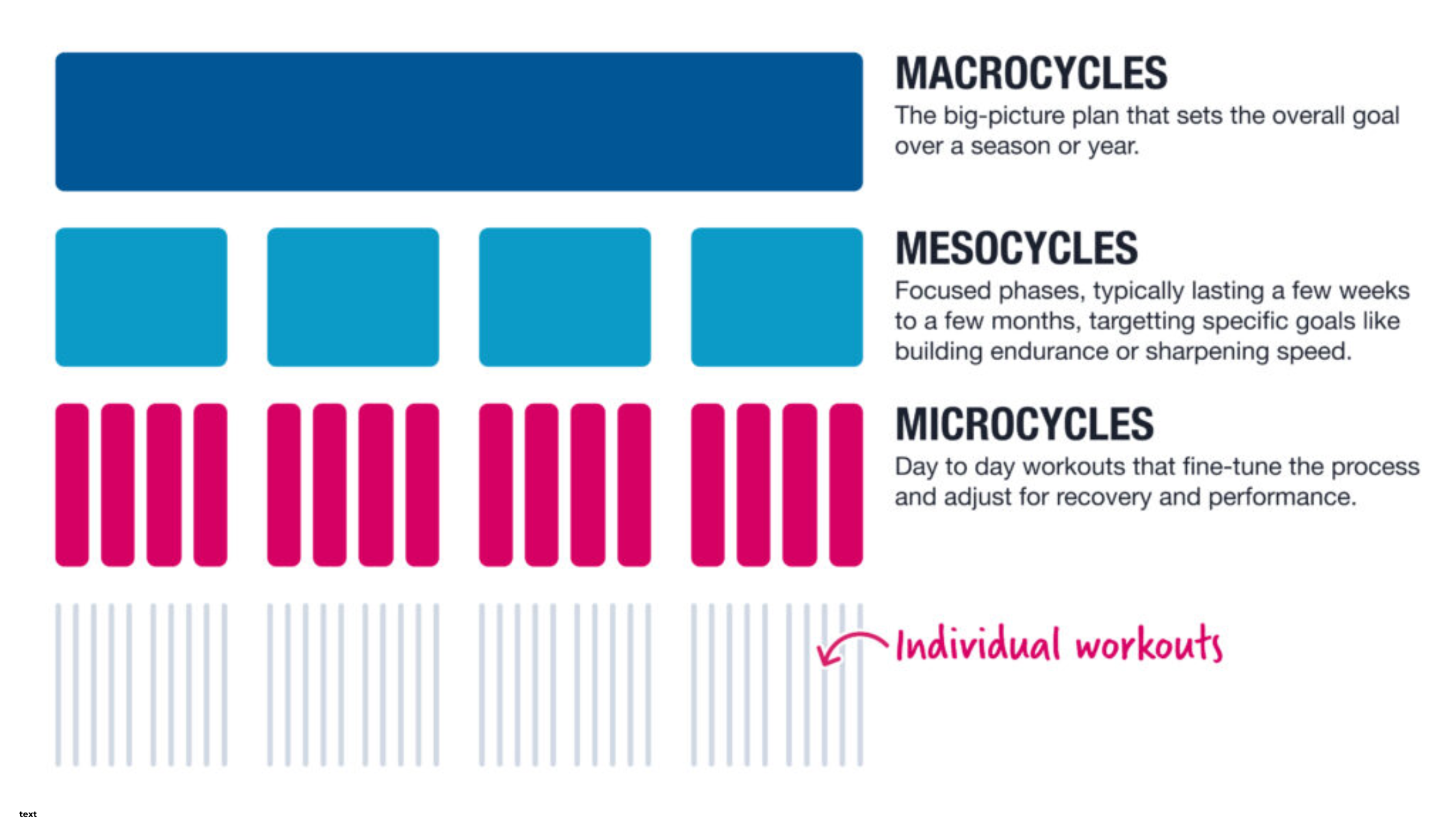
To understand periodisation properly, you need to understand three layers.
Macrocycles, mesocycles, and microcycles.
Think of them like this.
The macrocycle is the big picture.
The mesocycle is the training block.
The microcycle is the week.
Each one matters.
Macrocycle: The Big Picture Plan

A macrocycle is your long-term training plan.
For most cyclists, this usually covers 6 to 12 months.
It looks at the whole year and asks:
What are we building towards?
That could be a sportive, a cycling holiday, a race, a charity ride, a gravel event, or simply improving fitness and losing weight.
For example, if someone has a big event in July, we don’t want them flying in February and exhausted by May.
We want to build their fitness in phases so they arrive at the event fresh, strong, and confident.
A simple annual macrocycle might look like this:
Winter: Build strength, aerobic base, and consistency.
Early spring: Add more structured intensity and longer rides.
Late spring: Build event-specific fitness.
Summer: Peak for key events or cycling holidays.
Late summer/autumn: Maintain fitness and enjoy riding.
End of season: Recover, reset, and rebuild foundations.
For cyclists over 40, the macrocycle should also include planned lighter phases. You can’t expect to push all year.
There need to be periods where health, sleep, mobility, strength, and recovery become the priority.
That doesn’t mean fitness disappears.
It means you’re creating space for the next phase of progress.
Mesocycle: The Training Block

A mesocycle is a focused training block, usually lasting 3 to 8 weeks.
This is where the real work happens.
Each block should have a specific goal.
For example:
A base block might focus on Zone 2 endurance and strength training.
A build block might include threshold and sweet spot intervals.
A climbing block might focus on sustained power and low-cadence strength work.
A weight loss block might focus on consistency, nutrition tracking, and controlled training load.
A recovery block might reduce intensity and volume to let the body absorb previous training.
This is where a lot of cyclists get it wrong.
They try to improve everything at once.
They want to lose weight, increase FTP, ride longer, sprint better, climb faster, and add strength training all in the same block.
That usually ends in fatigue.
A better approach is to choose the main focus for each block.
You can still maintain other areas, but one priority should lead.
For example, if you’re in a strength-focused winter block, you might reduce the number of hard cycling sessions so your legs can recover from the gym.
If you’re in an FTP-focused block, you might keep strength work lighter and focus your energy on key bike sessions.
That’s how you make progress without burying yourself.
Microcycle: The Training Week

A microcycle is usually one week of training.
This is where the plan becomes real.
For cyclists over 40, the weekly structure is critical because recovery needs to be protected.
A good microcycle should balance hard sessions, easy sessions, strength training, rest days, and life commitments.
A common mistake is placing hard sessions too close together.
For example:
Monday: Hard gym
Tuesday: Hard intervals
Wednesday: Fast group ride
Thursday: Gym again
Friday: Tempo ride
Saturday: Long ride
Sunday: “Recovery” ride that isn’t really recovery
That might look productive on paper.
But for many cyclists over 40, that’s too much intensity and not enough recovery.
A smarter week might look like this:
Monday: Rest or mobility
Tuesday: Key interval session
Wednesday: Easy Zone 2 or recovery ride
Thursday: Strength training
Friday: Rest or short easy ride
Saturday: Long endurance ride
Sunday: Easy spin, mobility, or rest
This kind of week still includes quality.
But it gives the body more space to adapt.
The 3:1 Model For Cyclists Over 40
One simple periodisation model is three weeks building, followed by one easier recovery week.
This is called a 3:1 model.
Week 1: Moderate load
Week 2: Slight increase
Week 3: Highest load
Week 4: Recovery week
For younger athletes or very well-trained riders, this can work well.
But for cyclists over 40, I often prefer to be more flexible.
Some riders can handle three weeks of build.
Others do better with two weeks of build and one easier week.
For example:
Week 1: Build
Week 2: Build
Week 3: Recovery
Week 4: Build again
This can work especially well if someone has a stressful job, poor sleep, young children, or is adding strength training alongside cycling.
The key is not blindly following a model.
The key is watching how the body responds.
If power is dropping, sleep is poor, motivation is low, resting heart rate is elevated, or the rider feels flat, we may need to recover earlier.
That’s not weakness.
That’s good coaching.
Base Phase: Building The Engine

The base phase is usually the foundation of the year.
This is where you build aerobic fitness, improve durability, and create consistency.
For cyclists over 40, the base phase is also a great time to prioritise strength training.
The goal is not to smash yourself.
The goal is to become more resilient.
A good base phase might include:
Two to three Zone 2 rides per week.
One strength session, ideally two if time allows.
One short intensity session to keep the legs sharp.
Plenty of recovery.
Zone 2 training is important because it develops your aerobic engine. It improves your ability to use fat as fuel, supports mitochondrial development, and helps you build endurance without creating too much fatigue.
But Zone 2 still needs structure.
A two-hour Zone 2 ride when you’re fresh is very different from a three-hour Zone 2 ride when you’re stressed, under-fuelled, and tired.
The goal is controlled endurance work, not turning every ride into a hidden tempo session.
Build Phase: Adding Intensity

Once the foundation is in place, you can start adding more intensity.
This is where threshold, sweet spot, VO2 max, and climbing-specific sessions might come in.
But for cyclists over 40, intensity needs to be used carefully.
You don’t need hard intervals every day.
You need the right session at the right time.
Most riders only need one or two genuinely hard bike sessions per week.
More than that can work for some people, but it depends on sleep, nutrition, stress, and recovery capacity.
A build phase might include:
One threshold or sweet spot session.
One VO2 max or hill repeat session.
One long endurance ride.
One or two strength sessions, depending on fatigue.
Easy rides around those key sessions.
The hard days need to be hard enough to create adaptation.
But the easy days need to be easy enough to recover.
That’s where a lot of cyclists get stuck. They ride too hard on easy days and then can’t perform properly on hard days.
Peak Phase: Getting Ready For An Event

The peak phase is where training becomes more specific.
If your event has long climbs, your training should include sustained climbing efforts.
If your event is a long sportive, your training should include longer endurance rides and fuelling practice.
If your goal is a cycling holiday, your training might include back-to-back rides to prepare for multiple days of riding.
But this phase should not just be about doing more.
It should be about doing what is relevant.
For example, if you’re preparing for a 100-mile sportive, you don’t need to ride 100 miles every weekend.
You need to build enough endurance, practise fuelling, pace climbs properly, and arrive fresh.
The biggest mistake riders make before events is trying to prove their fitness too close to the day.
You don’t get fitter in the final week.
You get fresher.
Recovery Phase: Where Fitness Actually Shows Up
Recovery weeks are not wasted weeks.
They are where the adaptation happens.
During a recovery week, you might reduce volume by 30 to 50 percent. You might keep a small amount of intensity, but the overall load should drop.
This allows fatigue to reduce while fitness remains.
A good recovery week might include:
Shorter rides.
More Zone 1 and easy Zone 2.
Reduced gym volume.
More mobility.
Better sleep.
More attention to nutrition.
The goal is to finish the week feeling ready to train again.
Not guilty.
Not lazy.
Ready.
That’s a very different mindset.
Strength Training For Cyclists Over 40

Strength training becomes more important as we age.
After 40, maintaining muscle mass, bone density, and joint strength becomes a key part of long-term health and performance.
Cyclists often avoid strength training because they think it will make them heavy or tired.
But done properly, strength training supports cycling.
It can improve force production, climbing strength, posture, injury resistance, and long-term durability.
The key is periodising it properly.
In the off-season or base phase, you can focus more on building strength.
In the build phase, you maintain strength while prioritising bike performance.
Near an event, strength work should reduce so it doesn’t interfere with freshness.
A simple strength plan might include:
Squats or split squats.
Deadlifts or hip hinges.
Step-ups.
Calf raises.
Core work.
Upper body pulling and pushing.
Mobility work.
You don’t need bodybuilding volume.
You need enough strength work to support the body you want to ride with.
How To Combine Strength And Cycling
The biggest challenge is spacing sessions properly.
If you do heavy legs the day before hard bike intervals, don’t be surprised if your power is poor.
A better approach is to either place strength after a hard bike day or separate strength and hard cycling by at least 24 to 48 hours.
For example:
Monday: Rest
Tuesday: Intervals
Wednesday: Strength
Thursday: Easy Zone 2
Friday: Rest
Saturday: Long ride
Sunday: Easy spin
Or:
Monday: Strength
Tuesday: Easy ride
Wednesday: Intervals
Thursday: Rest
Friday: Zone 2
Saturday: Long ride
Sunday: Mobility
There is no perfect structure.
It depends on your life.
But the principle is simple.
Don’t let strength training ruin your key bike sessions.
And don’t let cycling fatigue ruin your strength work every week.
Nutrition Periodization

Training should be periodised.
Nutrition should be too.
That doesn’t mean making it complicated.
It means matching your nutrition to the demands of the day.
On hard training days, especially interval days or long rides, you need more carbohydrate.
On easier or rest days, you may not need as much.
If you’re trying to lose weight, the mistake is trying to create the biggest calorie deficit on your hardest training days.
That usually backfires.
You feel flat, power drops, recovery suffers, and then cravings increase later.
A better approach is to fuel the work.
Eat enough before and during hard sessions.
Then manage your calorie deficit away from training, mostly through normal meals and portion control.
This is something I use with clients all the time.
Fuel performance on the bike.
Manage body composition off the bike.
That distinction makes everything easier.
Recovery Markers To Watch

For cyclists over 40, recovery should be monitored.
Not obsessively.
But enough to spot patterns.
Useful markers include:
Sleep quality.
Resting heart rate.
Heart rate variability.
Mood.
Motivation.
Leg soreness.
Appetite.
Power output.
Heart rate response during easy rides.
If your heart rate is unusually high for a normal power output, that can be a sign of fatigue, dehydration, stress, or poor fuelling.
If your legs feel heavy but your heart rate looks normal, that might be more muscular fatigue.
If motivation drops and every session feels like a chore, that’s a warning sign too.
The more you understand your body, the better your training decisions become.
A Sample 12-Week Periodised Plan For Cyclists Over 40
Here’s a simple example of how a 12-week block could look.
Weeks 1 to 3: Base Build
Focus on Zone 2, strength training, consistency, and technique.
Week 4: Recovery
Reduce volume. Keep movement easy. Prioritise sleep and mobility.
Weeks 5 to 7: Build Phase
Add threshold or sweet spot intervals. Keep one long ride. Maintain strength.
Week 8: Recovery
Reduce load again. Check fatigue. Adjust zones if needed.
Weeks 9 to 11: Event-Specific Phase
Add longer rides, climbs, back-to-back sessions, or event-specific intervals.
Week 12: Taper Or Test Week
Reduce volume. Keep sharpness. Arrive fresh for the event or test.
This structure is simple.
But simple works when done consistently.
A Sample Week For A Time-Crunched Cyclist Over 40
If someone only had four to six hours per week, I’d keep it focused.
Monday: Rest or mobility.
Tuesday: Intervals, 45 to 60 minutes.
Wednesday: Strength training, 30 to 45 minutes.
Thursday: Zone 2 ride, 45 to 75 minutes.
Friday: Rest.
Saturday: Long ride, 2 to 3 hours.
Sunday: Easy spin, walk, or mobility.
That’s enough to improve fitness for many cyclists if done consistently.
You don’t need 12 hours a week to progress.
You need the right work, placed in the right order, with enough recovery to absorb it.
How To Know If Your Periodisation Is Working
A good plan should not leave you destroyed every week.
You should see signs of progress.
Your easy rides feel easier.
Your power improves at the same heart rate.
You recover faster between efforts.
Your motivation stays higher.
You sleep better.
You feel stronger in the gym.
Your long rides feel more controlled.
Your weight or body composition moves in the right direction if that’s a goal.
Progress is not always dramatic week to week.
But over 8 to 12 weeks, you should see a clear trend.
If you don’t, something needs adjusting.
When To Back Off
One of the best skills you can develop is knowing when to back off.
You should consider reducing training load if:
Your sleep has been poor for several nights.
Your resting heart rate is elevated.
Your HRV has dropped for several days.
Your legs feel dead before warming up.
Your power is low but heart rate is high.
You feel irritable or unmotivated.
You’re getting repeated colds or niggles.
You dread training.
This doesn’t mean you stop completely every time you feel tired.
But it does mean you should listen.
Sometimes the best session is the one you don’t do.
The Real Goal For Cyclists Over 40
The goal isn’t to become fragile in pursuit of fitness.
The goal is to become stronger, healthier, and more capable.
A good training plan should improve your cycling without wrecking the rest of your life.
You should still have energy for work.
You should still be present with family.
You should still enjoy riding.
You should feel like training supports your life, not consumes it.
That’s the biggest shift I try to help cyclists make.
Cycling is important.
But health comes first.
And when health improves, cycling usually improves with it.
Conclusion
Periodisation is not just for professional cyclists.
It might be even more important for cyclists over 40.
Because once life gets busier and recovery becomes more limited, you can’t rely on random hard riding anymore.
You need structure.
You need progression.
You need recovery.
You need strength training.
You need weeks where you push and weeks where you absorb the work.
That’s how you build fitness without burning out.
So if you feel stuck right now, don’t immediately ask how you can do more.
Ask whether your current training is organised well enough to help you adapt.
Because after 40, the best cyclists aren’t always the ones who train the most.
They’re the ones who recover well enough to benefit from the training they do.
Whenever you're ready, here are the ways I can help you:
- The Cycle Lean Coaching: Personalised 1:1 Coaching for Cyclists Who Want to Drop 6–12 kg and Add Up To 60 Watts of FTP While Riding 6-8 hours a Week!
- The Cycle Lean Blueprint: The science-backed 12-week blueprint to cycle leaner, climb stronger, and become the most resilient version of yourself.
I am an ambassador for:
Awesome Supplements: Award Winning Supplements — Our plant-based awesome protein powder is 100% UK-made with low-sugar, gluten & dairy-free.
The best protein powder I have ever tasted.
Get 10% off any product/ every time you make a purchase when using my code: DAMERELL10 at Awesome Supplements.