Over 40? This Metric Might Matter More Than Your FTP

The Climb (#163)
Over 40 and Still Want to Improve? Start Tracking This.
Most cyclists over 40 don’t have a training problem.
They have a recovery problem.
You can still push hard. You can still increase FTP. You can still climb better than you did five years ago.
But recovery doesn’t bounce back like it used to.
And that’s where heart rate variability (HRV) and sleep become powerful tools.
Not trends. Not gimmicks. Actual physiology.
What Is Heart Rate Variability (HRV)?
HRV measures the variation in time between heartbeats. It reflects how well your autonomic nervous system is balancing stress (sympathetic) and recovery (parasympathetic).
Higher HRV generally indicates better recovery and adaptability. Lower HRV suggests accumulated stress, fatigue, illness, or insufficient recovery.
Research strongly supports HRV as a tool for endurance athletes:
- Kiviniemi et al. (2007, 2010) showed that HRV-guided training improved aerobic performance more than fixed training programs.
- Plews et al. (2013) found HRV closely tracks endurance training status in elite athletes.
- Bellenger et al. (2016, Sports Medicine) concluded HRV is a reliable marker of training adaptation and fatigue.
In simple terms: HRV can tell you when to push, and when to back off.
And that becomes more important as you age.
Why HRV Matters More After 40
As we get older:
- Parasympathetic activity naturally declines
- Recovery capacity reduces
- Hormonal stress responses change
Research by Umetani et al. (1998) demonstrated that HRV declines with age in healthy adults. That doesn’t mean performance has to decline, it just means recovery needs more attention.
If you’re over 40 and training hard without monitoring recovery, you’re guessing.
HRV gives you early warning before overtraining, illness, or burnout hits.

The Sleep Connection (This Is Huge)
HRV and sleep are deeply linked.
Poor sleep reduces parasympathetic activity and lowers HRV.
- Fullagar et al. (2015, Sports Medicine) found sleep restriction impairs performance, recovery, and hormonal balance in athletes.
- Simpson et al. (2017) showed even partial sleep deprivation negatively affects endurance performance.
- Sauvet et al. (2010) demonstrated that sleep loss significantly reduces HRV, indicating higher physiological stress.
There’s more.
Sleep deprivation increases ghrelin (hunger hormone) and reduces leptin (satiety hormone), according to Spiegel et al. (2004). That makes weight management harder, even if training stays consistent.
So if you’re trying to improve power-to-weight over 40, sleep is not optional.
It’s a performance tool.

What This Means for Cyclists Over 40
If you’re:
- Waking up tired
- Needing more caffeine
- Plateauing in training
- Getting ill more often
- Struggling to lose weight
It may not be your training plan.
It may be your recovery capacity.
And HRV plus sleep tracking can highlight that before it spirals.
Practical Steps to Improve HRV and Recovery
Let’s make this real and practical.
Recently, I measured my own HRV for a week using a standard heart rate monitor synced to a free app called Elite HRV.
Nothing fancy. No subscription band. No long-term commitment.
Just seven consecutive mornings, measuring at the same time, under the same conditions.
That gave me a baseline.
Then I tracked my sleep alongside it, simply how many hours I got each night.
What I noticed was clear:
On nights where I slept longer, my HRV score improved.
On nights where sleep was shorter or disrupted, HRV dropped.
Not dramatically. But consistently enough to show the relationship.
That’s the value of tracking.
You don’t always need to monitor HRV 365 days a year. In fact, I don’t think most recreational cyclists need constant monitoring.
But using something like Elite HRV for a focused 7–14 day block — especially during heavy training, stressful work periods, or when trying to understand plateaus — can give you incredibly useful feedback.
I’m not affiliated with Elite HRV, but it’s simple, free, and works with most chest strap heart rate monitors.
You don’t need a Whoop band or the latest wearable to start understanding your recovery.
Here’s How to Use HRV Properly
1. Establish a Baseline (7 Days Minimum)
Measure first thing in the morning:
- Before caffeine
- Before getting out of bed
- Same position each time
Look at trends, not single numbers.
2. Track Sleep Alongside It
Write down:
- Hours slept
- Sleep quality (1–5 scale)
You’ll likely notice patterns quickly.
More sleep → higher HRV
Less sleep → lower HRV
That awareness alone changes behaviour.
3. Use It as a Guide, Not a Judge
If HRV trends downward for 3–5 days:
- Reduce intensity
- Prioritise sleep
- Avoid stacking hard sessions
If HRV trends stable or upward:
- You’re likely recovering well
- Harder sessions are better tolerated
It’s feedback, not a verdict.
And About Wearables…
Whoop, Garmin, Oura — they’re all useful tools.
But you don’t need to track HRV constantly unless you enjoy data.
Short, focused tracking blocks can be just as powerful. Especially if your goal is simply to understand how sleep, stress, and training interact in your body.
Over 40, that self-awareness is often more valuable than another hard session.
Because the goal isn’t just to train hard.
It’s to recover hard enough to keep training.
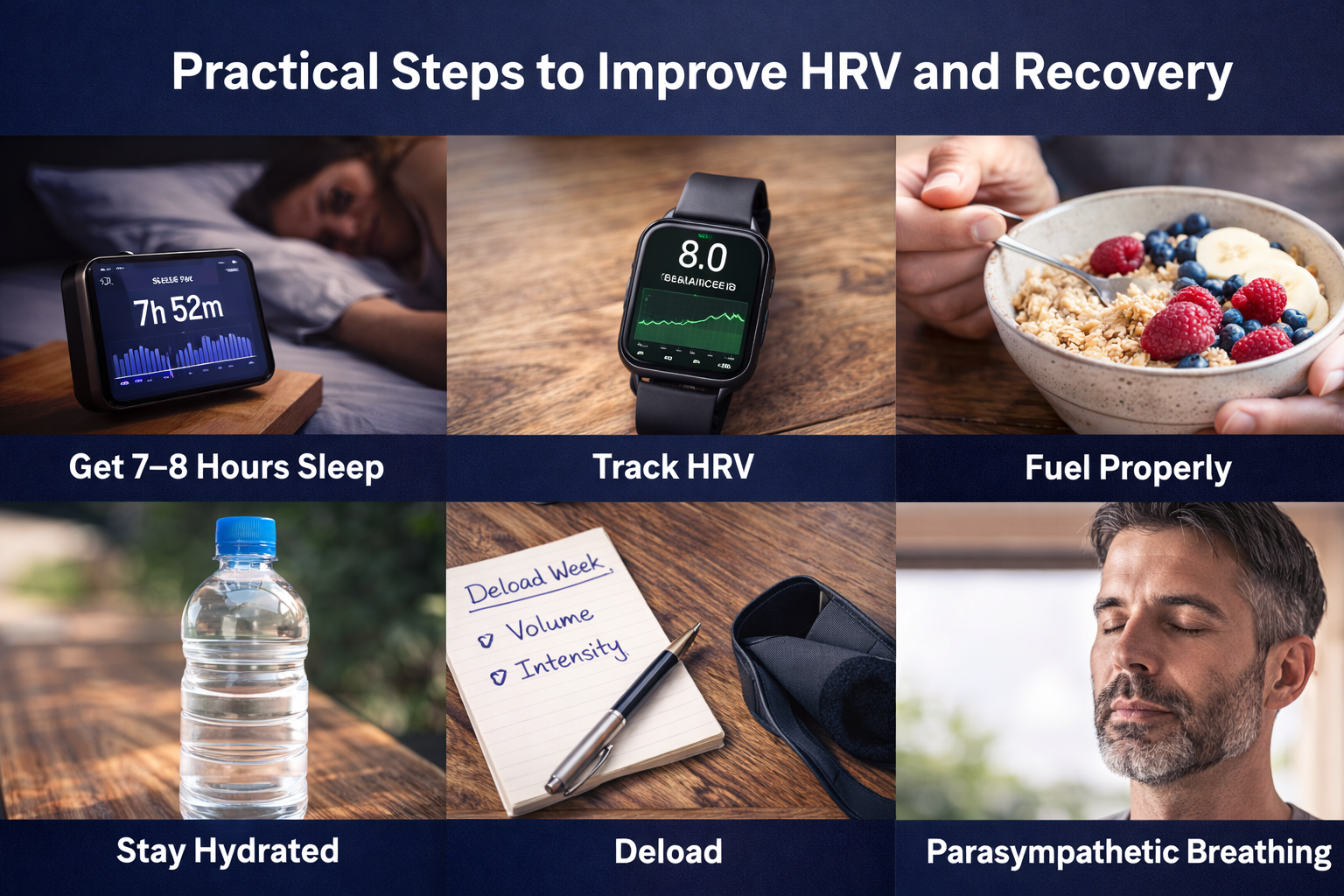
2. Protect 7–8 Hours of Sleep
Sleep is when:
- Growth hormone is released
- Muscle repair occurs
- Autonomic balance resets
Simple upgrades:
- Fixed bedtime and wake time
- Dark, cool room (16–19°C)
- No screens 60 minutes before bed
- Reduce alcohol (it crushes HRV)
- Stop caffeine 8 hours before sleep
Even adding 45–60 minutes per night can significantly improve recovery metrics.

3. Fuel for Sleep, Not Just Training
Under-fuelling harms sleep.
After hard sessions:
- Eat carbs at dinner
- Include 20–40g protein before bed
Low-carb evenings after intense rides can impair sleep quality and recovery.
4. Schedule Deload Weeks
Every 3–5 weeks:
- Reduce volume by 30–40%
- Maintain light intensity
- Increase mobility work
Planned recovery prevents forced recovery.

5. Add Parasympathetic Recovery Work
Just 5–10 minutes daily of:
- Slow nasal breathing (4–6 breaths per minute)
- Short walks outside
- Light mobility work
These stimulate vagal tone and improve HRV over time.
The Real Shift
At 25, you can ignore recovery and still improve.
At 45, recovery is the training.
Smart cyclists over 40:
- Train hard when HRV supports it
- Back off when recovery signals drop
- Treat sleep like FTP work
- Stop glorifying exhaustion
Because the goal isn’t just to get faster next month.
It’s to keep getting faster for the next 10 years.
Whenever you're ready, here are the ways I can help you:
- The Cycle Lean Collective: Get ready to transform your fitness journey with our new and improved 1-2-1 coaching programme.
- The Cycle Lean Blueprint: The science-backed 12-week blueprint to cycle leaner, climb stronger, and become the most resilient version of yourself.
I am an ambassador for:
Awesome Supplements: Award Winning Supplements — Our plant-based awesome protein powder is 100% UK-made with low-sugar, gluten & dairy-free.
The best protein powder I have ever tasted.
Get 10% off any product/ every time you make a purchase when using my code: DAMERELL10 at Awesome Supplements.